
Stuck in Hell: Pandémonium
(2025)

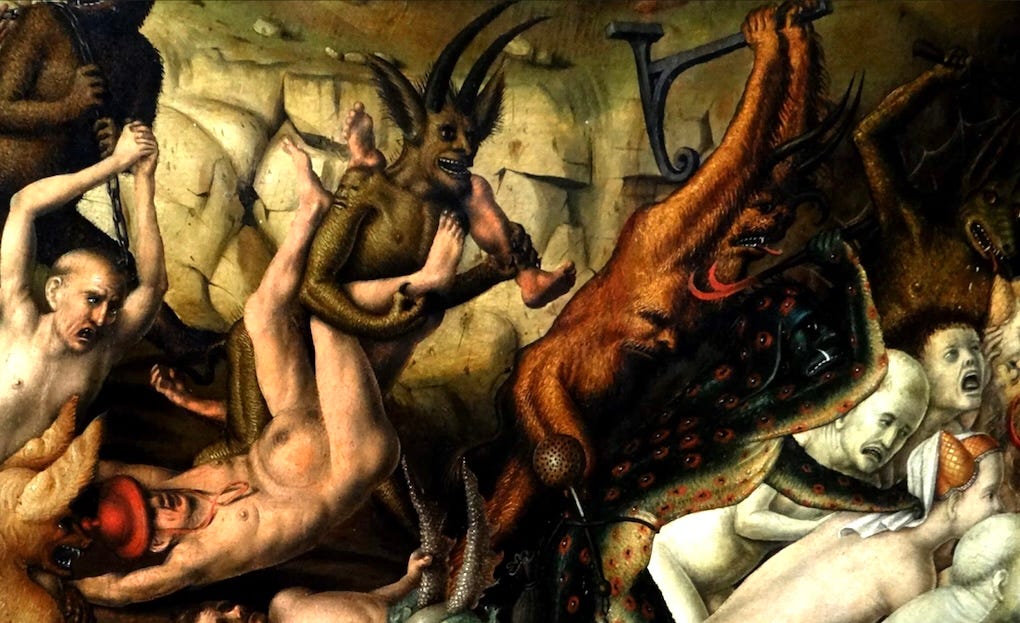
Composer François Narboni is still obsessed with the first piece of music he composed: his Opus 1, a 1988 work for solo harpsichord in which dissonant, rhythmically uneven ostinatos repeat in obsessive loops. The piece, called Pandémonium, sounds like being trapped in an eternal loop of intricate pain and torture.
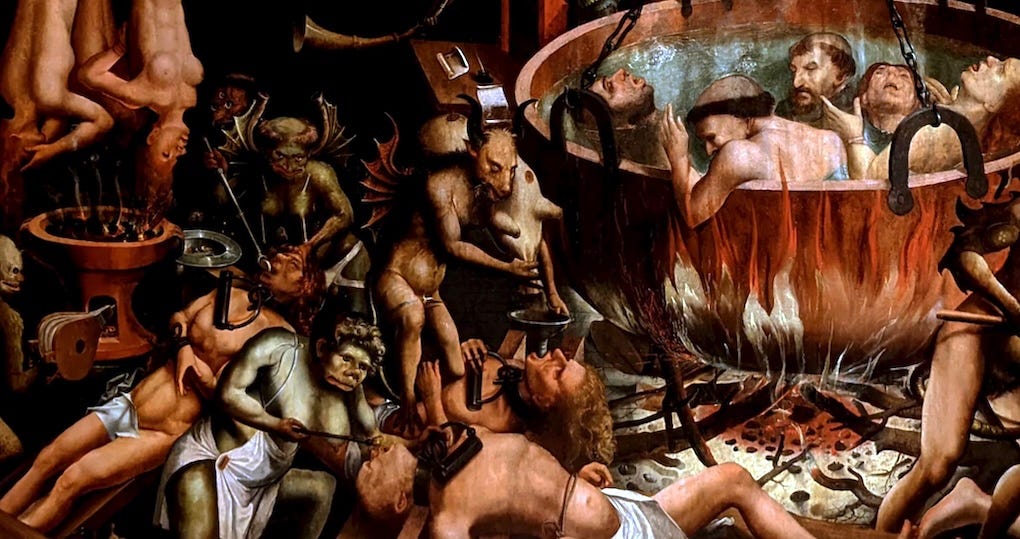
He asks his friend and long-time collaborator, Bob Kohn, to create a video work for this music. Kohn is already investigating a genre of 15th century paintings, panoramic landscapes of Hell, painted by such artists as Hieronymus Bosch and Jan Van Eyck, and Kohn composes a film based on close-up details from these paintings, moments of confusion, terror, and perversion, snippets from an old European vision of the eternal torments which are the fate of sinners.
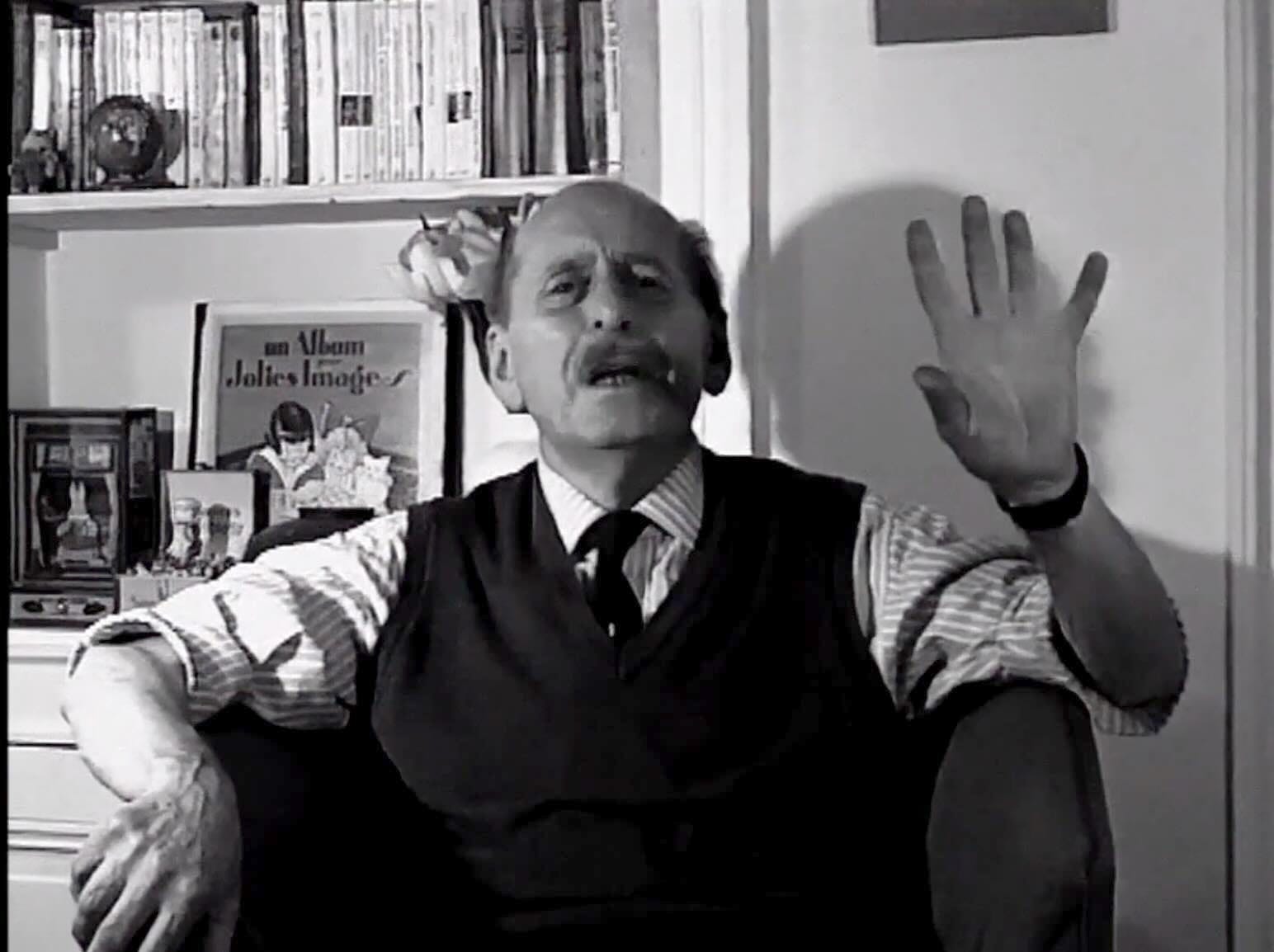
But, like Narboni, Kohn is obsessed with an old work of his own, a film he made nearly 40 years ago, an interview with his own father, a Hungarian Jew who only barely managed to escape from the Holocaust and from the Nazi camps. Kohn brings his father’s memories of massacres and humiliations into the film as well, using the Holocaust as a classic example of our human ability not only to imagine Hell and depict it in paintings, but to impose an actual living hell on our fellow human beings.
Holocaust narratives have, in 2026, become a familiar staple in films. They no longer have the power and shock that audiences first experienced with Lanzmann’s Shoah in 1985. What does it mean for Kohn, who’s own father counted up 70 members of his immediate family who were murdered by the Nazis, to resurrect this footage now, to accompany Narboni’s musical torture loops, also dating from 40 years ago? They are bringing back music and memories from the past, into a world which is now very different, and it now has a different rhetorical weight. We now live in a world were we are told that because the Jews suffered a genocide 80 years ago, it is “anti-Semitic” to mention that Israeli Jews are committing genocide today in Gaza. For Narboni and Kohn, the pull of past suffering is still alive; they have not escaped the loop. “Never Forget” is the slogan of Holocaust Remembrance, but the hidden message is “never apply what happened before to what it happening now, especially if the genociders are now Jewish.” The original intent behind “Never Forget” is that only by constantly hammering home the overwhelming depravity and evil of the Holocaust can we prevent it from happening again. This approach has now proven to be a complete failure.
What is driving Israeli Jews, as a culmination to their 80 year search for safety and security, to end by turning into their own tormentors, creating their own hell on earth, and pushing the Gazans into the inferno? What drives American politicians to fund the genocide, and salivate over their visions of luxury resorts being built in Gaza, on top of the bones of Palestinian children? What drove voters in Weimar Germany, suffering under the harsh terms of the Armistice and economic collapse, to elect and support a government that cast the Jews as the cause of their problems? Kohn’s father recounts how, when the Jews of Budapest were forced to wear a yellow Star of David at all times, they didn’t feel shame, but felt that the Nazis had brought shame upon themselves for what they were doing. By building a hell on earth and pushing others into it, we create a hellish world for ourselves as well.
One might object that the subject of Gaza forms no part of the film at all, and therefore there is no reason to bring it into a discussion about the film. But in 2026, with Israel’s complete destruction of Gaza and the Gazan people in front of us at every moment, the subject of Gaza in the film is deafening, overwhelming in its absence. Its unspoken presence is felt in every frame.
Narboni’s musical loops circle endlessly, searching in vain for an exit, a way off of the treadmill. Kohn’s old footage of his father replays endlessly in his head, always haunted by the past, always fearful of the new danger, never healing. Bosch’s sinners wander up and down on circular platforms, screaming as swords are plunged into giant human ears, and monsters try to eat their own tails. The traumatized Israeli nation is so freaked out, generation after generation, that it won’t rest until it has made the Palestinians suffer in the same way that their own ancestors suffered. Pandémonium, the capital city of Hell, is a film of this loop, a cinematic expression of an all too human trap where we continue to torment ourselves and others, long after the devils and demons are gone.
My articles on experimental film are freely available to all, but are supported by monthly and annual donations from readers. Please consider becoming a paid subscriber to support my work. Thank you.