
Illuminations: Time Drawings Volume I
(2025)

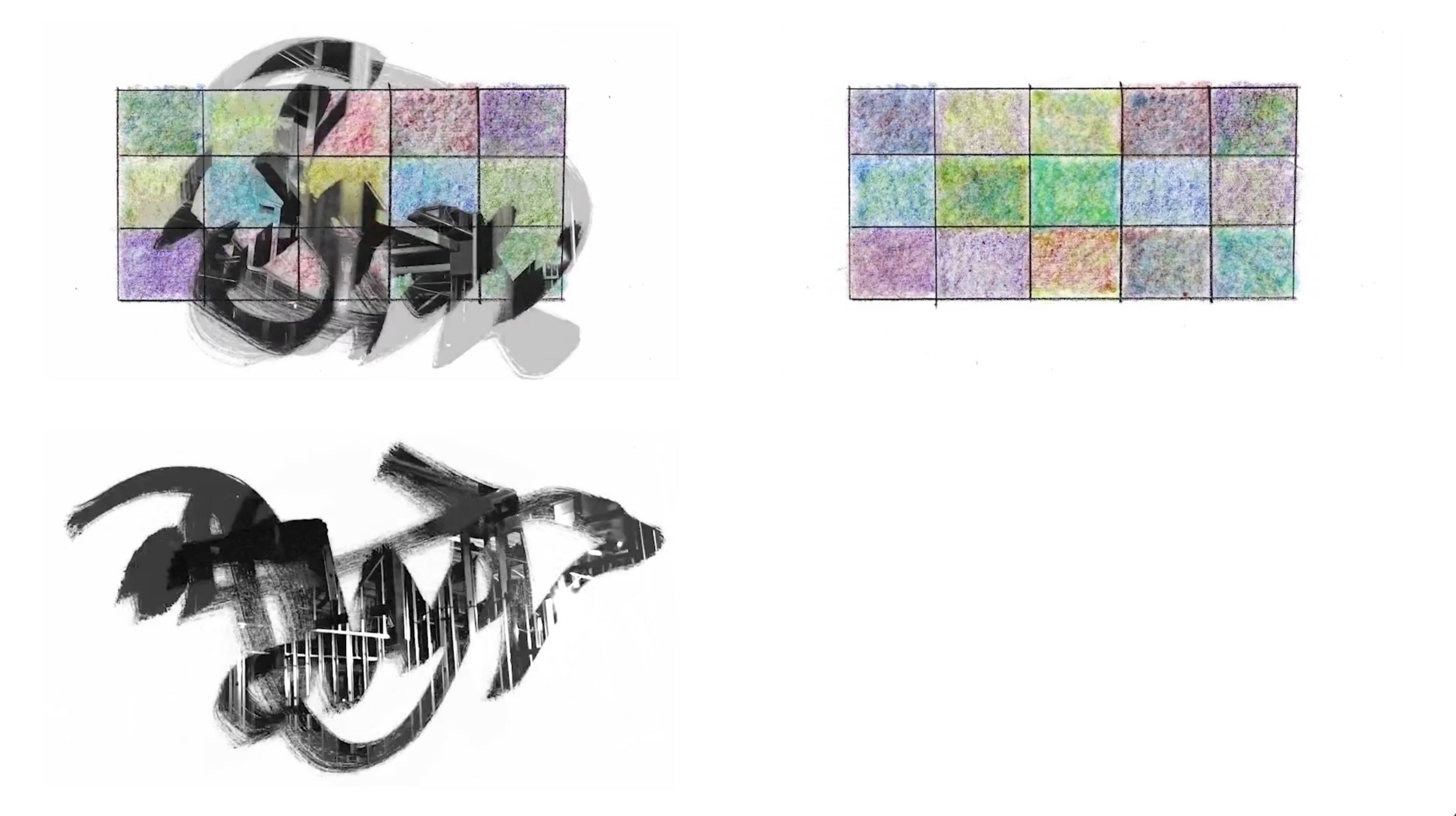
Time Drawings Volume I is a collection of 15 short video works by Van McElwee, ranging in duration from half a minute to two and a half minutes. One could think of these miniature abstract studies as visual haiku: condensed statements which blend visual elements of color, line and movement with sound textures to create an evocative moment or poetic quality. McElwee describes the works as “modular,” in the sense that they could also be viewed in different groupings, or in a different order, than the way they are presented here. He assembled this particular collection for a screening at the Kranzberg Arts Foundation in St. Louis.
A description of some of these works:
In Clusters, dark squiggly lines appear in the four corners of the screen, over a white background. The lines jiggle and squirm restlessly, and, within their outlines, we see footage of metal bars, such as one might see in a prison or other restricted area. Behind the squiggles, we see grids of color squares, 5 x 3, the crayon colors slowly shifting over time. We hear the sound of metallic clattering, as if someone were running a spoon over the metal bars. The visual elements continually appear, fade, and reappear in the four corners, in ever-changing combinations, contributing to the overall scintillating effect of clusters of color, line, and sound.
In Hypnogogic Manuscript, we see two symbols, written in a gleaming script which looks like it could be glitter glue over a grey background. The symbols could be ideographs, runes, heraldry, shapes that seem both pictographic and significant, but in an unknown language, and their forms shift continually, as we hear suspended, bell-like tones. The forms are tantalizing, with their suggestion of hidden significance.
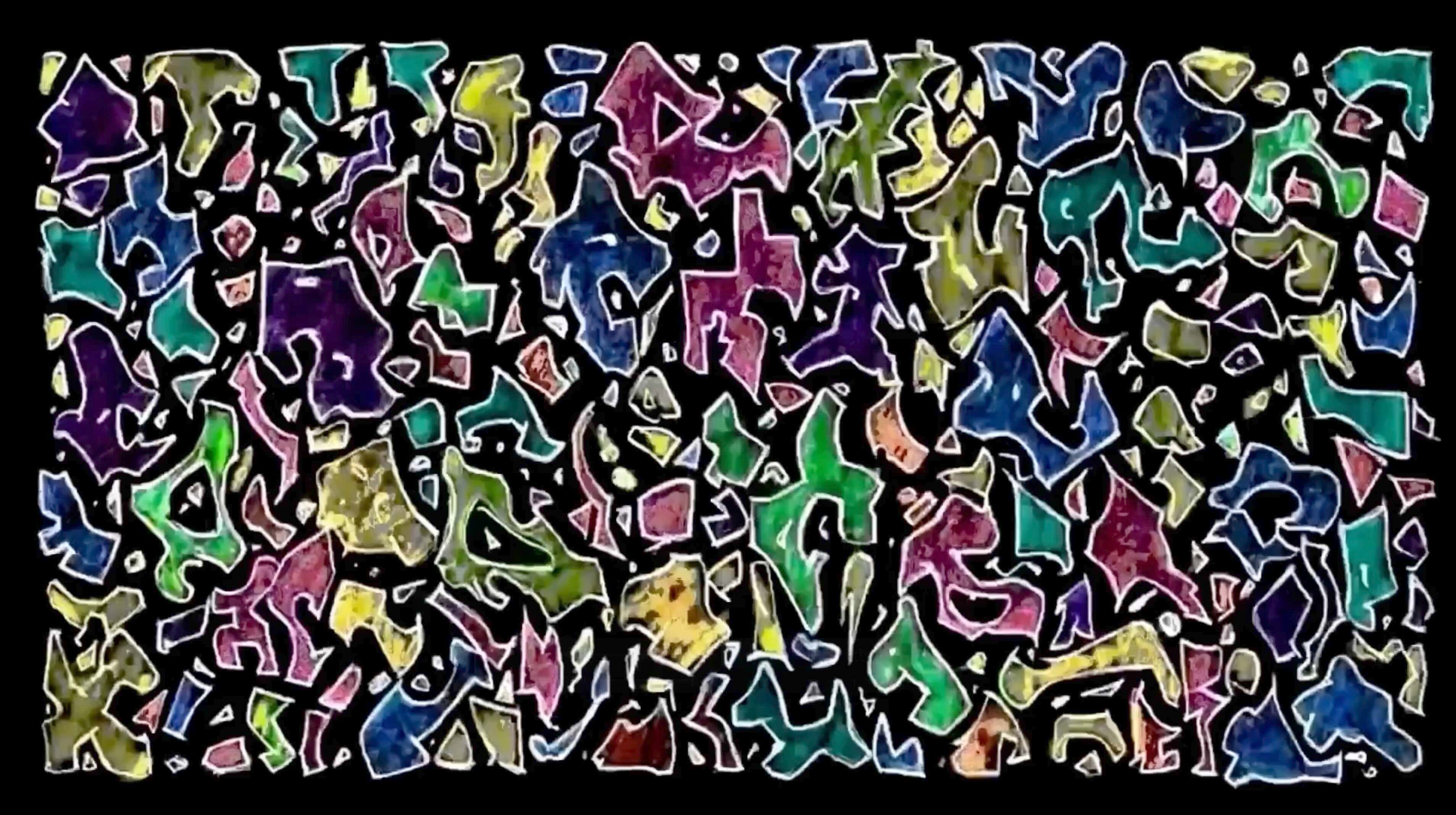
In Four Fossil Bricks (Plasticine), one of the shortest pieces, we hear a shimmering, chaotic sound, almost like sirens inside an echoing cave. We’re looking at colored shapes, closely packed together on a black background, that could be jigsaw puzzle pieces, or primitive drawings of animals. These shapes constantly re-form themselves, punctuated by frequent bursts of black frames with silence.
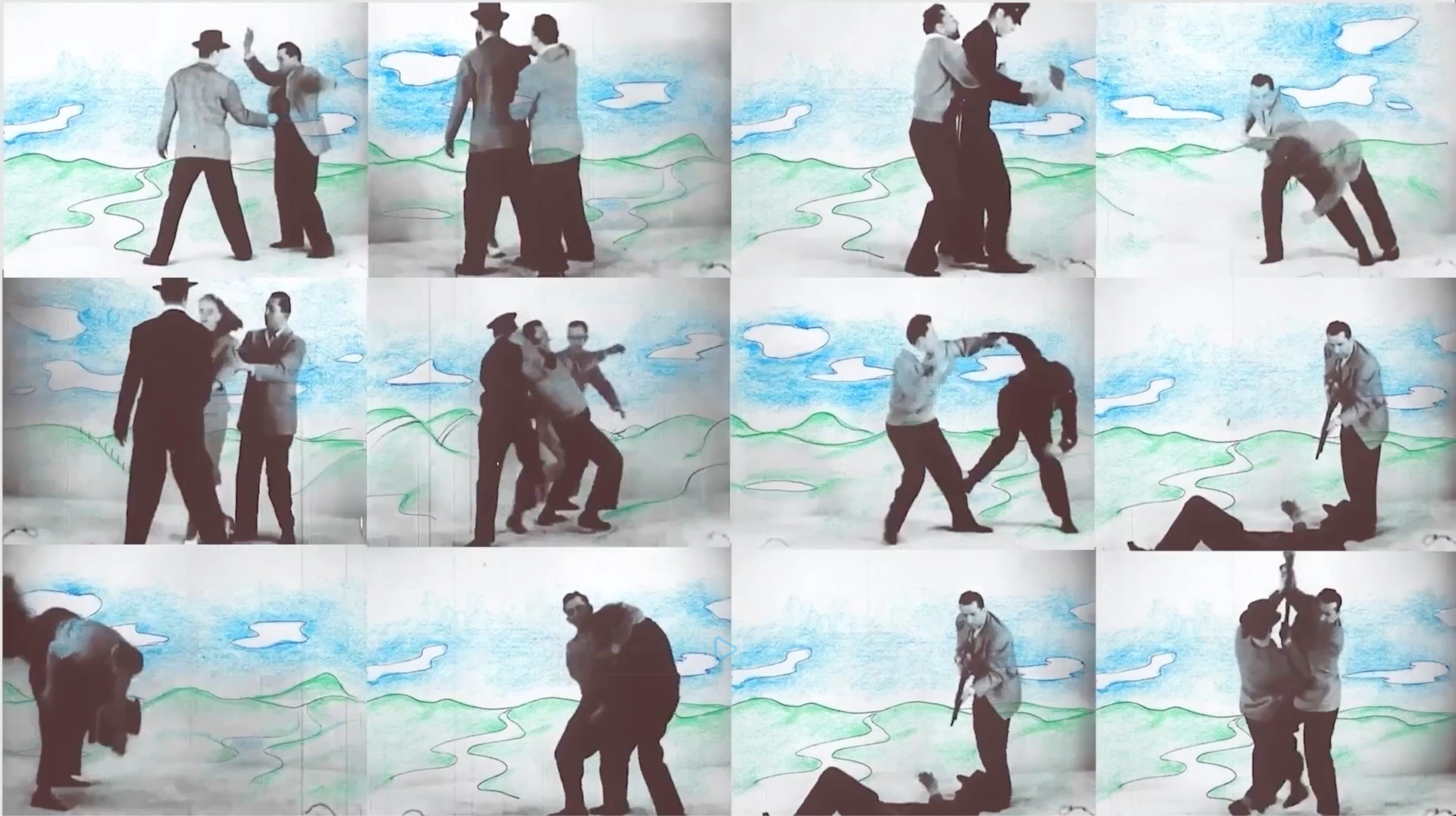
In Survival Comix, the screen is divided into a 4 x 3 grid, each rectangle playing different sequences in which two men and a woman fight with a policeman. The vintage costumes, black and white photography and low frame rate make these sequences look like outtakes from an early silent film, and the violent encounters manage to seem both desperate and comic at once. Each frame has a hand-drawn background with green hills, a river, and a pacific blue sky in a simple style of watercolor paint. We hear the extended sound of a snare drum roll, as if all of these sequences, with the crooks and the cop alternately gaining the upper hand as they fight, are merely a giant wind-up to a punchline.
In Slow Noise, we see a background that does indeed like live broadcast video “snow” on an old, analog TV set, but slowed down. Over this background, we can barely discern more organized forms: chains of lightly colored dots, spiraling up and down. These forms might suggest the resonant energy fields emitted by strands of DNA, and soon colored blobs appear, morphing like microorganisms in a petri dish. Life seems to emerge spontaneously from the random noise.
In Destination, we’re looking at black and white footage of a snowy landscape, speeding past a train or car window. Superimposed over this, we see a stylized representation of a doorway. The frame of the door is made of constantly shifting lines, but the inside remains resolutely black and empty. Overall, the sequence suggests the human journey, as we hurtle through time, towards and ultimate destination which is unknown and unknowable.
Verandah, a somewhat longer piece at two and a half minutes, shows a glass-enclosed corridor in a modernist building, extending out into an impressionistic crayon drawing of a winter woodland. The landscape constantly transforms, with flashing color fields and black crayon slashes indicating plant forms which grow and change. Features of the landscape constantly interpenetrate the glassed-in corridor, enhancing the architectural qualities of a space designed to feel like it’s both indoors and outdoors. Are the trees reflected on the polished floor, or are they growing right up through the floor?
Some of these works are completely abstract in intention, exploring qualities of movement, line and color for their own sake, creating brief moments of aesthetic illumination. Others speak metaphorically of other human and spiritual concerns: life, time, evolution. McElwee has made many previous works in a longer format, often between 15 and 25 minutes, and he has shown himself to have a real mastery of that format, so it is fascinating for me to see him turn his attention here to these much shorter works. In this condensed format, there is generally no time to slowly transform and develop ideas, as he did in his earlier works. Like haiku, these works provide brief bursts of illumination, and they operate by suggestion and implication. They each have a unique power and energy, some quiet and some bold, and they linger in the mind much longer than their brief appearance on the screen. This gives us the opportunity to imagine our own way of developing the ideas, as they linger in our memory, a special kind of gift which this shorter form makes possible.
My articles on experimental film are freely available to all, but are supported by monthly and annual donations from readers. Please consider becoming a paid subscriber to support my work. Thank you.