
Dreams Deferred: I Exist
(2026)

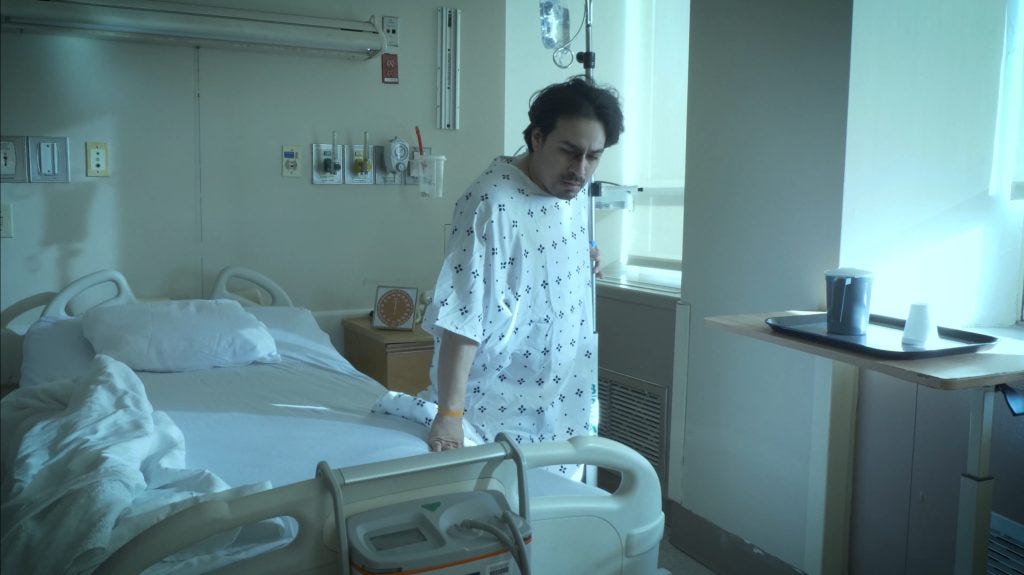
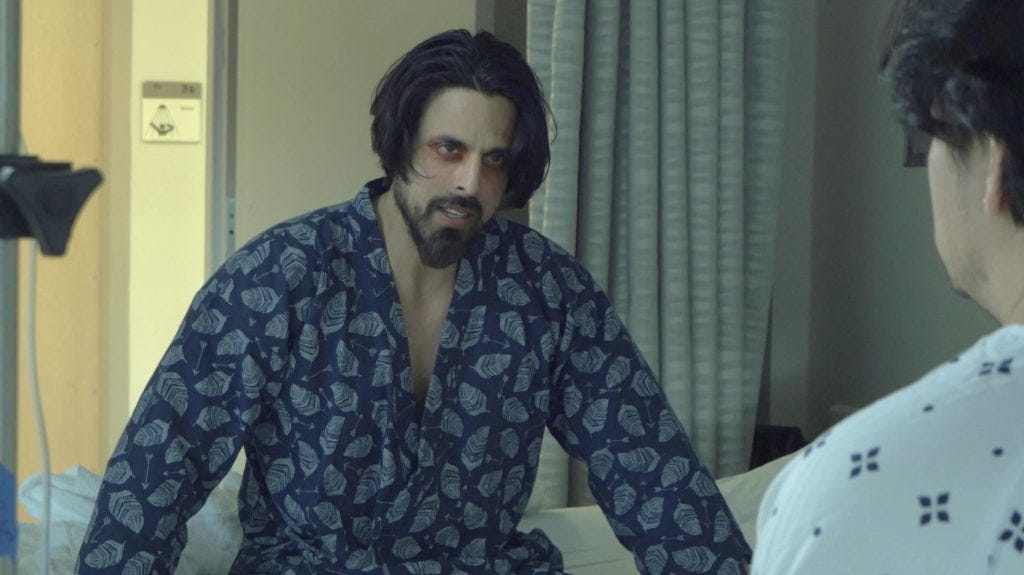
In I Exist, a 15 minute short which is Martin del Carpio’s latest existential, allegorical narrative, Jordan Martinez (Giovanni Sandaval) wakes up in a hospital room with a black eye, not quite sure how he got there, other than his own tendency to “take things too far.” He has a philosophical conversation with another patient in his shared room, a portentous and intimidating man (Alan Tavaraz) who’s odd manner implies he may be Jordan’s hallucination. Their talk consists of commonplace observations about the difference between merely “existing” and really “living.” Jordan, it seems, suffers from an inner emptiness, despite his successful job and marriage. He once had unnamed dreams and ambitions for self-fulfillment in his youth, but he let them pass by.
He receives a cursory discharge exam from Nurse Linda (Tessie Herrasti), another hallucinatory figure, wearing white face like a Kabuki princess, who offhandedly confesses that she, too, had a youthful ambition that is still unfulfilled.
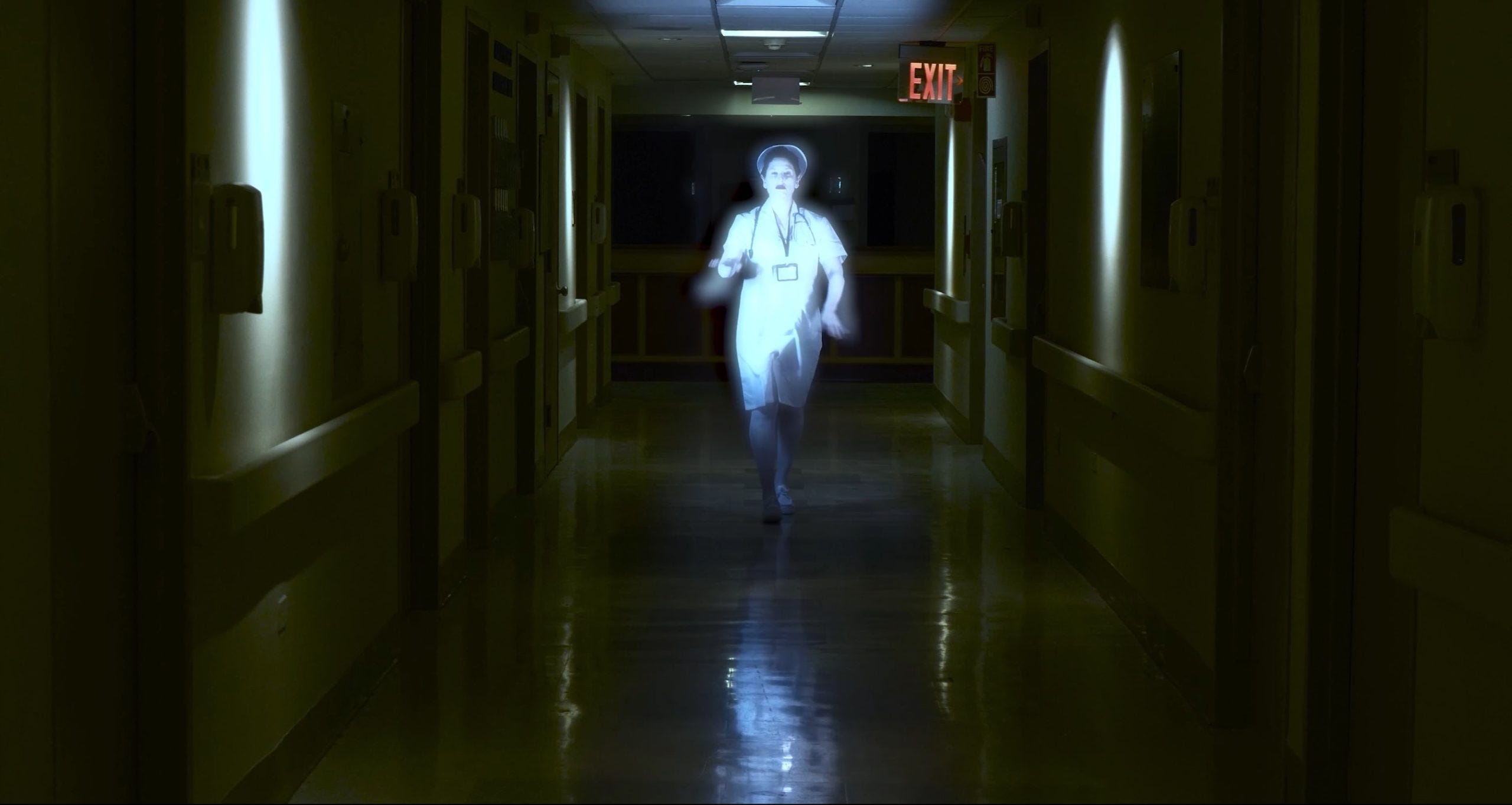
In Jordan’s talk with his roommate he complains that his life has been reduced to merely “existing,” but it becomes increasingly unclear if he or anything around him has a solid existence. Both roommate and nurse have vanished. He wanders around the empty hospital floor, terrified, the hall lights shorting out, while he himself seems to flicker in and out of existence. Stumbling into a room marked “No Exit,” he seems trapped in a Bardo state, neither dead nor alive. Through the window, even the city outside is devoid of inhabitants, as everything dissolves into a blinding white light.
The narrative in I Exist, really an outline, a highly suggestive sequence of moments, constructed from elements which walk the line between cliché and archetype, functions poetically, as a meditation on the fragile flame of life, caught by the camera at the point of flickering and going out. In a largely unexamined life, like Jordan’s, events, like the one that landed him in the hospital, simply happen to him, beyond his control or understanding. He finds himself completely confused and disorientated about who and where he is in his life, about the focus and purpose of living. Long ago, an inner voice tried to tell him why he is here and what his mission is, but he fell into the the habit of ignoring the voice. He stumbles around, bewildered by the looming emptiness that seems to open up around him, wondering where the tactile, vital, fullness of life has gone.
The hospital setting itself serves as a potent voice in the story, an emblem of the mechanistic, secular and transactional nature of modern life, and it acts as a kind of giant vacuum, sucking the vitality and meaning out of our lives. At the moment of dying, our ancestors might have been surrounded by chanting shamans, burning incense to help us on our journey, or by church elders, singing the hymns we had heard since childhood. Instead, for Jordan, medical professionals, just as disoriented and alienated as he is, go through the motions of checking his bodily functions with machines, while ignoring his soul. Jordan finds himself in a hospital where all the people have vanished, and we find ourselves feeling weak and powerless, living in a society where all the humanity has vanished. That inner voice from long ago, trying to guide us, has fallen silent. Del Carpio’s short but powerful filmed meditation shines a light on an emptiness which is so pervasive that we barely notice it.
My articles on experimental film are freely available to all, but are supported by monthly and annual donations from readers. Please consider becoming a paid subscriber to support my work. Thank you.